BlackRock Transfers Millions in Bitcoin and Ethereum Amid Ri
Published On : December 27, 2025
[
In a notable move within the cryptocurrency landscape, asset management giant BlackRock has transferred substantial sums of Bitcoin and Ethereum into Coinbase. This development emerges amid increasing concerns from analysts about the possibility of a prolonged bear market, with CryptoQuant emphasizing mounting risks of a downturn. Understanding the implications of BlackRock’s actions and CryptoQuant’s market signals provides valuable insights into the current state and potential future trajectory of digital assets.
BlackRock’s Significant Cryptocurrency Transfers
Recent on-chain data reveals that BlackRock, one of the world’s largest asset managers, moved a considerable amount of cryptocurrencies to Coinbase, a prominent exchange platform. Specifically, the firm deposited:
- 2,292 BTC, valued at nearly $200 million
- 9,976 ETH, approximately $29.23 million
This transfer follows a trend of outflows recorded by Bitcoin and Ethereum ETFs, suggesting a possible shift in BlackRock’s investment strategy—potentially liquidating or repositioning its holdings. The movement of such significant sums into Coinbase indicates a deliberate action that warrants attention from market participants, as it could signal intentions to offload these assets or prepare for strategic repositioning.
Market Context and Recent ETF Flows
The recent outflows from Bitcoin and Ethereum ETFs align with wider market sentiment, which has been characterized by persistent downward pressure. Data from SoSo Value shows that:
- The Bitcoin ETFs experienced a net daily outflow of approximately $189 million on December 23, with BlackRock’s outflows totaling around $157 million.
- Ethereum ETFs similarly saw daily outflows of about $96 million, with $25 million exiting BlackRock’s ETHA fund.
Such sustained outflows over consecutive days underscore a shift of institutional and retail capital away from dominant cryptocurrencies during a tense phase of the market. Despite rallying stocks and gold markets, Bitcoin has struggled to sustain gains above key resistance levels, trading below the $90,000 mark and failing to capitalize on broader bullish sentiment.
Analyst Perspectives and CryptoQuant’s Bear Market Indicators
CryptoQuant, a leading analytics platform, has flagged the increasing probability of a bear market scenario. Their analyst, Woominkyu, highlighted that the Bitcoin Combined Market Index (BCMI)—a composite measure reflecting market sentiment—has been returning to the 0.5 zone since October 21. This level traditionally indicates a cooling phase in the market cycle, rather than the peak of a bullish run.
Since then, Bitcoin’s price has declined significantly, dropping below previous support levels and reinforcing the notion that the market has not only cooled but also reset in terms of on-chain momentum and price action.
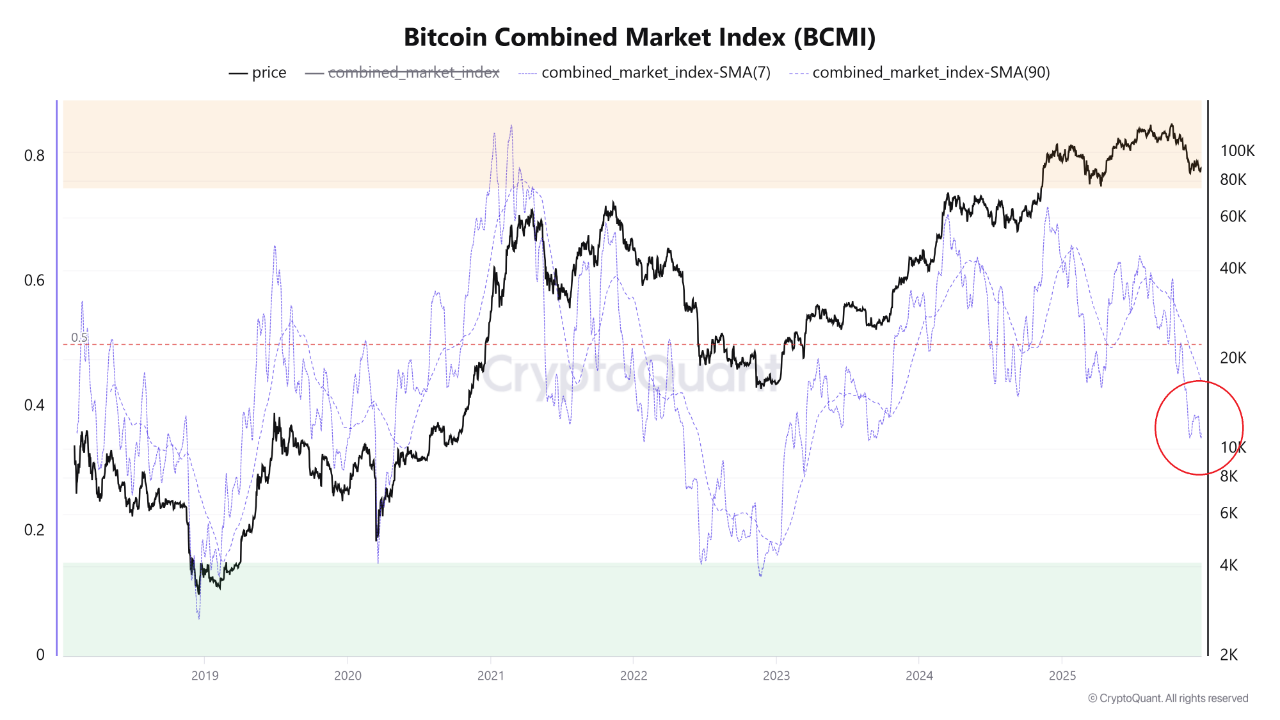
Historically, the BCMI has signaled full sentiment compression and structural reset at levels around 0.25 to 0.35, reflecting market bottoms in previous cycles. Currently, BCMI remains below equilibrium but still exceeds those historical bottom zones, indicating that while the market has cooled, it may be transitioning into a more sustained bear phase rather than a temporary pullback.
Implications for Bitcoin and Ethereum Prices
If past market patterns repeat, the current signals suggest the possibility of a deepening decline rather than a simple correction. Notably, industry veteran analyst Peter Brandt recently pointed out that major market cycles have historically experienced declines of up to 80%, implying Bitcoin could see prices as low as $25,000 in a prolonged bear market scenario.
Furthermore, the continuous pattern of ETF outflows in recent trading days supports the hypothesis of increasing institutional apathy or strategic repositioning, which could weigh heavily on prices in the coming weeks.
Despite Bitcoin and Ethereum’s resilience in prior bullish cycles, the combination of large institutional transfers and bearish on-chain signals suggests caution is warranted for investors currently expecting quick recovery.
Conclusion
The recent large-scale deposits of Bitcoin and Ethereum by BlackRock into Coinbase, coupled with CryptoQuant’s cautious market analysis, highlight a period of heightened risk for the crypto market. As institutional players reevaluate their holdings amidst signs of a potential bear market, traders and investors should remain attentive to on-chain indicators and macroeconomic factors that could influence future price movements. While the digital asset space continues to evolve, understanding the interplay between institutional actions and market signals remains critical for navigating the uncertain phases ahead.
Frequently Asked Questions
What does BlackRock’s transfer of cryptocurrencies into Coinbase indicate?
This action may suggest that BlackRock is preparing to liquidate or reposition its Bitcoin and Ethereum holdings, possibly reflecting a bearish outlook or strategic portfolio management.
How reliable are CryptoQuant’s BCMI signals in predicting market bottoms?
CryptoQuant’s BCMI has historically been a useful tool for identifying sentiment shifts and market resets. However, like all indicators, it should be used in conjunction with other technical and fundamental analyses.
Could Bitcoin still recover despite current bearish signals?
While recovery is always possible, the prevailing on-chain signals and institutional movements indicate increased downside risk. Investors should approach with caution and consider the broader macroeconomic environment.
Is a $25,000 Bitcoin price level likely in the near future?
Analysts like Peter Brandt have highlighted historical declines of up to 80% in major cycles, which could place Bitcoin’s potential lows around $25,000 in a severe bear scenario. However, actual market conditions may vary.
What should investors do during such market caution?
It is advisable to diversify, stay informed about on-chain and macro signals, and consider risk management strategies such as stop-loss orders or reducing exposure until market clarity improves.